
SEO in Daily Life 2026: How You Use It Every Day Without Knowing
The Invisible Mechanics of Local Search Engine Optimization
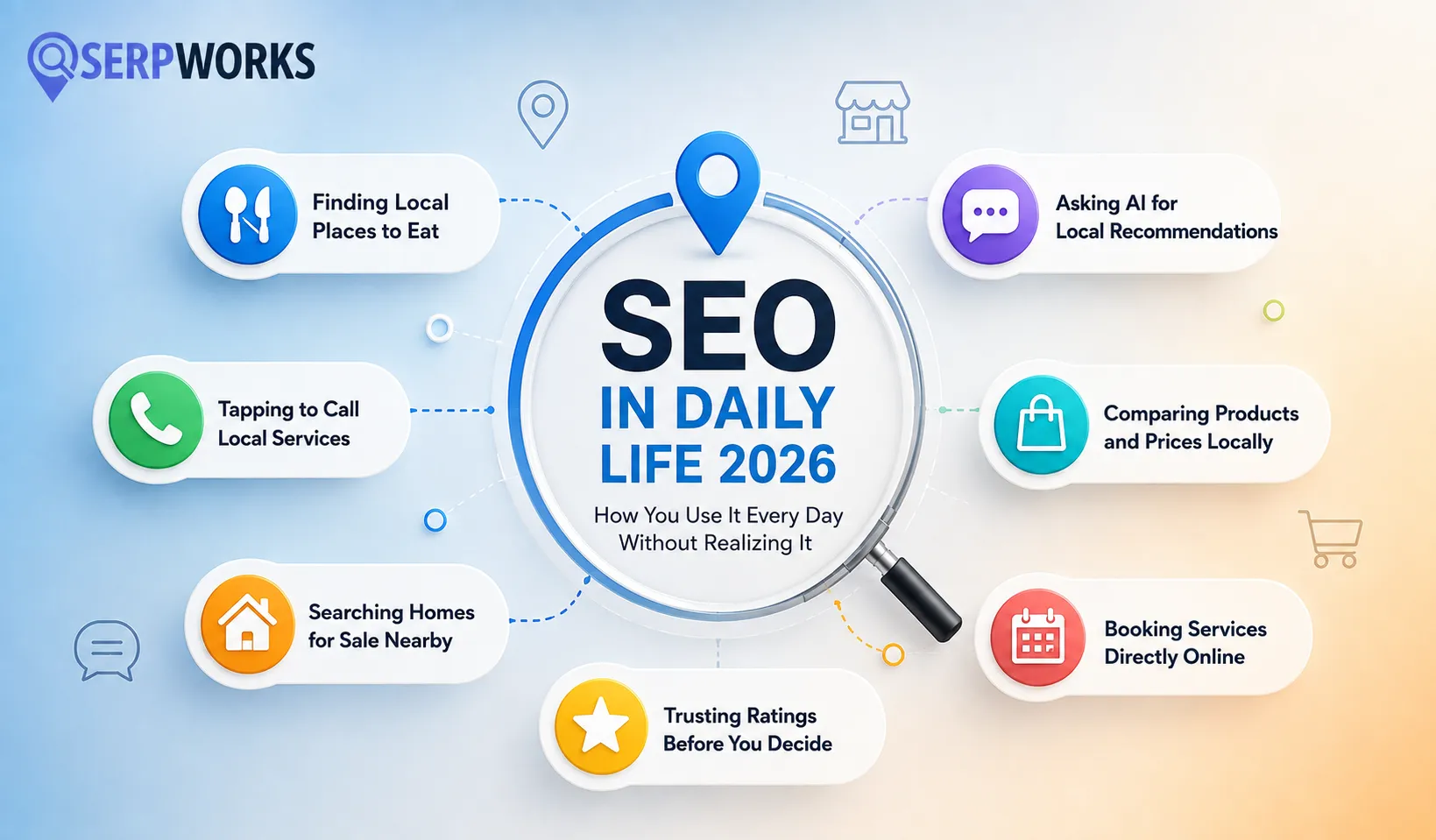
Before lunch, before you booked a haircut, before you called a plumber, you probably already used search engine optimization today. Not the technical kind marketers argue about, but the quiet, invisible kind that decides which business shows up the moment you need one. Here is what is actually happening behind seven moments you probably lived through this week.
Searches / Day Worldwide
Google handles roughly 13.7 billion searches a day worldwide based on its confirmed run rate of over 5 trillion annual queries, with nearly half of those searches carrying clear local intent.
Picking Lunch Off Google Maps
You get hungry, open Maps, and type "best lunch spot near me." In seconds you pick a place with a 4.6 star rating and an "Open Now" tag. That is not luck. Google's Local Pack ranks results on three factors: proximity to your GPS location, prominence built from review count and rating, and relevance drawn from Google Business Profile optimizations.
✦ Before Google Maps, There Was a Tire Company
The Michelin Guide was created in 1900 by tire manufacturers Édouard and André Michelin. France had fewer than 3,000 cars at the time. The brothers published free maps and restaurant listings simply to get people driving more, so they would wear out their tires and buy replacements.
— Culinary Arts Academy SwitzerlandTapping Call on an Emergency Plumber
Water is leaking under the sink. You search "emergency plumber in my neighborhood," skip the websites entirely, and tap Call on the first map listing. The service provider who wins that tap relies on expert local citation management and three critical setup elements:
Reference: Why House Numbers Exist
The modern system of consecutive street numbering originated in 18th-century Paris and London to streamline tax collection and conscription, not to help customers find local businesses.
— Anton Tantner (Histoire & Mesure Journal), House Numbers: An International HistoryScrolling a Map of Homes for Sale
You search "3 bedroom home for sale in your area," filter by price, and scan pins on a map before clicking one with clear photos and a floor plan. Real estate listings run on structured schema data—fields that tell search engines the exact price, square footage, and location of a property. Listings missing that technical structure quietly disappear from filtered searches.
Historical Etymology: Why It Is Called "Real" Estate
Latin (Res / Realis): Contrary to the popular myth that "real" meant royal property, it derives from the Late Latin realis (from res, meaning "physical thing").
Legal Distinction: English common law used "real property" to distinguish permanent, immovable physical assets (land & buildings) from movable "personal property" (clothing & livestock).
— Online Etymology Dictionary & Oxford English DictionaryAsking an AI Assistant Where to Go
While driving, you ask an assistant, "Where can I get my brakes checked around here on a Saturday?" It reads back one business and offers directions. That single answer comes from AI models reading structured citations and verified operating hours—confirming Saturday availability and verified service tags directly, heavily aligned with modern Google natural language understanding principles.
✦ Google Maps Origins
Google Maps launched in February 2005, months after acquiring Where 2 Technologies; within six months it integrated satellite imagery and layered local business pins.
— Google Official Product HistoryComparing a Product Before You Buy It
Standing in a store, or scrolling at home, you search "is this brand worth it" or scan a product to compare prices at a shop down the street. Behind that moment, search engines are reading product data feeds, GTIN codes, and local inventory listings, matching what is on the shelf near you against what you just typed.
On June 26, 1974, a pack of Wrigley's Juicy Fruit gum became the first product ever scanned with a UPC barcode at a Marsh supermarket in Troy, Ohio—proof the system worked for retail items.
— Smithsonian InstitutionBooking a Salon Straight From Search Results
You decide it is time for a haircut, search "top rated salon in my city," and tap a "Book Online" button embedded right inside the search result—no separate website visit needed. That button exists because the business connected their scheduling engine to search ecosystem APIs.
✦ Online Booking Started With One Man's Frustrated Wife
OpenTable was founded in 1998 after its creator watched his wife struggle for weeks trying to book a restaurant reservation by phone. It established patterns nearly every local booking button still follows today.
— Harvard Digital Innovation Case StudyTrusting a Star Rating Before You Even Call
You will not book the salon, call the mechanic, or visit the clinic without glancing at its rating first. That habit is newer than it feels, and through strategic reputation & review management, it functions as one of the primary ranking signals a local business can build.
How Star Ratings Became a Ranking Signal
Epinions launches as one of the first platforms where ordinary users could publicly review products and local services.
It established the universal 5-star crowd-sourced rating model that modern digital platforms still rely on today.
That exact framework is now a primary trust & prominence signal for search algorithms, fully matching Google's search quality documentation.
Turning Daily Searches Into Real Foot Traffic
Visit Within 24 Hours: Roughly 76% of people who run a "near me" search on their mobile phone visit a physical business within 24 hours—and a rapidly expanding segment now consults conversational AI tools to discover local recommendations.
None of this requires your customers to think about SEO. That is exactly the point. Every single one of those seven daily moments quietly rewards businesses with a complete, accurate, and well-categorized local search presence, while bypassing the ones without it.
Building that presence correctly—securing a verified Google Business Profile, managing consistent citations across directories, and creating location-based search strategies—is the specialized work that freelancers on Serpworks execute for growing brands every day.
Ready to Hire a Local SEO Expert?
Browse top-rated Google Business Profile specialists, citation builders, and local search strategists on Serpworks.
Find Local SEO Freelancers